Mathematics in a Changing World
Mathematics has always helped human beings understand the world. In the first part of this Geopo Maths Insights Series, we looked at its story through the past. In the second, we explored how students learn it in the present. Now we come to the final question: what place will mathematics have in the future?
The answer is simple, but powerful. Mathematics will remain one of the main languages of the future because it helps us reason clearly, measure change, recognise patterns and make better decisions. The OECD describes mathematical literacy as the ability to reason mathematically and use mathematics to solve problems in real-world situations. That is exactly the kind of thinking students will need in a world shaped by data, technology, science and uncertainty.
For a High School student, this future begins with familiar topics: algebra, graphs, geometry, probability, statistics, ratio and equations. These may look like school lessons today, but they are also the early building blocks of engineering, computer science, economics, medicine, architecture, climate research and space exploration. A student who learns mathematics well is not just preparing for an exam. They are learning how to think.
Where Mathematics Is Already Shaping the Future
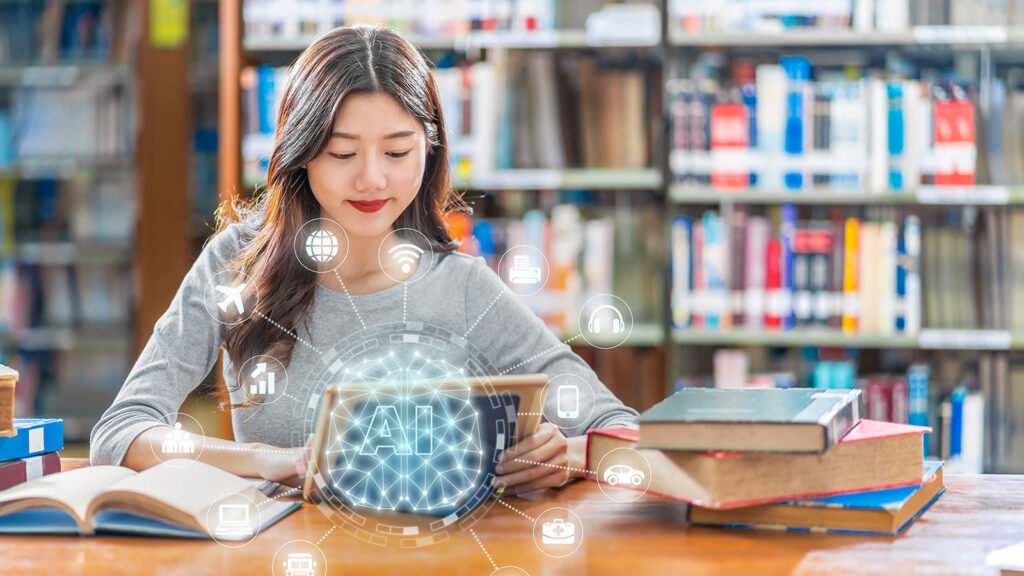
Artificial intelligence is one of the clearest examples. AI may feel like magic when it writes text, recognises images or recommends videos, but it is built on mathematics. Linear algebra helps organise information. Probability helps machines deal with uncertainty. Statistics helps systems learn from data. Optimisation helps them improve. Researchers also need mathematics to understand the limits of AI, because faster computers alone cannot answer every question about reliability, accuracy or fairness. The US National Science Foundation has highlighted the need for deeper mathematical foundations to understand the capabilities and limitations of modern AI systems.
Data science is closely connected. Every day, people and organisations collect huge amounts of information: health records, weather readings, travel patterns, financial data, online behaviour and scientific measurements. Mathematics helps turn this information into useful knowledge. It also teaches us to ask careful questions. Is the data complete? Is the conclusion fair? How certain are we? In the future, students will not only need to use technology. They will need to judge whether technology is being used wisely.
Robotics, engineering and architecture show another side of mathematics. A robot needs geometry to understand position, angles and movement. Engineers use calculations to test safety, strength and efficiency. Architects use measurement, proportion and shape to design buildings that are both useful and beautiful. Mathematics does not remove creativity. It gives creativity structure.
The same is true in medicine, climate science, space exploration, finance and cybersecurity. Medical researchers use statistics to study treatments and compare evidence. Climate scientists use mathematical models to understand how the atmosphere, land, ocean and sea ice interact. NOAA describes global climate models as complex mathematical representations of major climate system components and their interactions.
Space missions also depend on measurement, equations and careful estimation. Orbits, landing paths, rocket design and communication with spacecraft all require mathematical thinking. Finance and economics use mathematics to compare risk, cost and possible outcomes. Cybersecurity uses mathematical ideas to protect information. The National Academies of Sciences, Engineering, and Medicine notes that modern mathematical research supports advances in fields such as artificial intelligence, precision medicine, manufacturing and cybersecurity.
Even everyday life is full of hidden mathematics. GPS, online banking, weather forecasts, search engines, delivery apps, video games and digital maps all depend on mathematical ideas. Most people do not see the equations, but the equations are there, working quietly in the background.
The Skills Students Need for Tomorrow
The future of mathematics is not only about machines. It is also about human thinking.
Mathematics trains the mind to slow down, look for patterns, test ideas and explain conclusions. These habits are valuable in any career. A doctor needs evidence. An engineer needs accuracy. A business leader needs judgement. A programmer needs logic. A designer needs structure. A citizen needs the ability to question numbers, graphs and claims.
This is why mathematical thinking is becoming more important, not less. In the future, many routine calculations may be done by computers. But people will still need to decide what to calculate, what the answer means, whether it is trustworthy and how it should be used. A calculator can produce a number. A human being must understand the problem.
For students entering High School, the best preparation is not to rush into advanced topics too early. The best preparation is to build strong foundations. Understand algebra instead of memorising steps. Learn how graphs tell stories. Treat geometry as a way of seeing space. Take probability and statistics seriously, because they help us understand uncertainty. Try small projects: compare travel times, analyse temperatures, plan a budget, measure a room or explore patterns with simple coding.
A brief UAE perspective is also worth noting. The UAE is investing in education, technology, innovation, artificial intelligence and scientific research. That makes it a strong environment from which students can prepare for global opportunities. But the message is not only local. Wherever a student studies, strong mathematics opens doors.
The future will need data scientists, engineers, doctors, economists, architects, software developers, researchers, teachers, cybersecurity specialists, climate scientists and many other professionals who think mathematically. Not every student must choose a mathematics-heavy career, but every student benefits from mathematical confidence.
Mathematics is not simply a school subject. It is a universal language for patterns, logic, structure, change and possibility. It helped humanity understand the past. It helps students learn in the present. And it will continue to shape the future.
If you are ready to build the mathematical skills needed for tomorrow’s world, discover how Geopo Maths helps students develop strong foundations through expert online Maths Tuition.
Author: Geopo Maths Editorial Team